
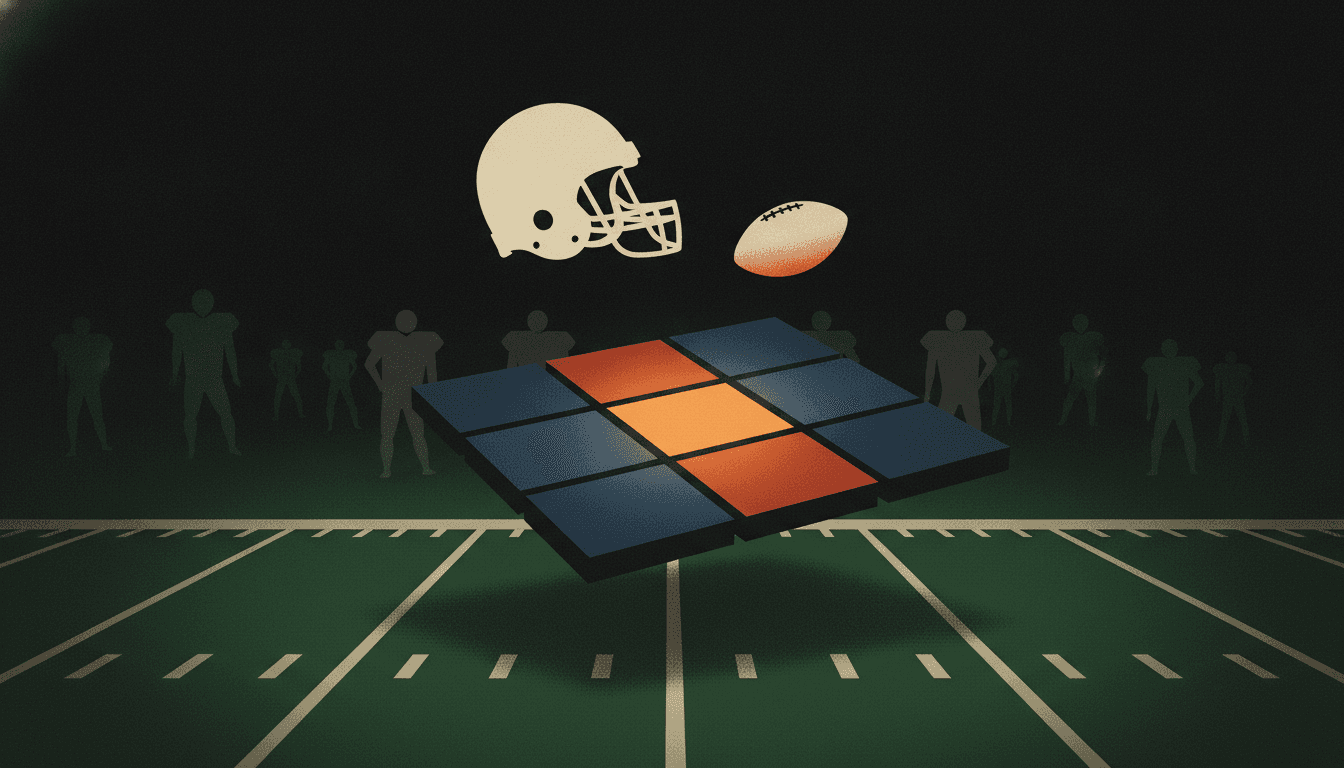
An NFL grid game gives you nine empty squares and nine guesses. Every square is where a row meets a column - the Eagles crossing the Cowboys, the 49ers crossing "Pro Bowl," the Packers crossing "5,000 career rushing yards" - and your job is to name a real player who fits both. That is the whole game, and it has quietly become one of the most-played football trivia formats on the internet, because knowing a superstar's résumé matters less than remembering who played where. This guide covers the two boards most people mean when they search for an NFL grid game: Immaculate Grid Football, the Sports Reference original, and Gridiron Grid, the daily board here on sacked.gg. It walks through each one's rules as its own site states them, the categories cell by cell, three worked cells with every fact checked against Pro-Football-Reference, the traps that cost a guess, and how rarity scoring works on each.
What an NFL Grid Game Is
The format is a 3×3 grid. Three categories run down the side and three run across the top, and each of the nine cells asks for one player who satisfies both the row and the column it sits in. Most categories are teams, so the typical cell is a two-franchise question: who suited up for both the Giants and the Jets? The rest are awards, stat milestones and career shapes - Pro Bowler, Hall of Famer, 10,000 career passing yards, drafted in the first round, played for only one team. Nine guesses is the budget on both boards described below, and on both a player can be used once. The skill is not naming the best player who fits; it is naming any player who fits, and saving your best-traveled veterans for the cells where nobody else will do.
How Immaculate Grid Football Works
Immaculate Grid is a daily trivia game run by Sports Reference, the people behind Pro-Football-Reference, and the football edition's rules are published on its own page. You select a player for each cell matching that cell's row and column. You have nine guesses to fill the grid, and every guess counts whether it is right or wrong. After nine guesses the game ends and you get two numbers: a score out of nine, and a rarity score based on how obscure your answers were. If any guesses were wrong you can keep guessing after that, but those extra guesses do not change your score. A new grid arrives every day at 6:00am ET, a player cannot be used twice, and players can be active or retired from the NFL, the AFL or the AAFC. The page counts its grids in sequence; the one served on November 3, 2026 was grid number 1,202.
The rules get specific about what "fits" means, and the specifics are where grids are won. For a team-and-team cell the player must have played at least one game, regular season or playoffs, for both teams. For a team-and-award cell the player must have won the award in a season he appeared for that team, and "All-Pro" means first-team Associated Press All-Pro only. A Hall of Famer must be inducted as a player. For a team-and-season-stat cell the stat has to be recorded with that team in a single season; the page's own example is Christian McCaffrey in 2022, who ran for more than 1,000 yards split between Carolina and San Francisco and therefore matches 1,000 rushing yards for neither. For a team-and-career-stat cell the player just has to have played for that team at some point; the page's example is Josh McCown, who passed for 17,731 career yards across nine teams and matches 10,000 passing yards with every one of them.
How Gridiron Grid Works
Gridiron Grid is the sacked.gg version of the format, and it is one of the site's daily games rather than a standalone. The board is the same 3×3. The three rows are NFL teams; the columns are one more team, an award category, and a career category, which is a stat milestone on some days and a college, a draft slot or a career shape on others. You get nine guesses for nine cells, a wrong guess costs a guess rather than a cell, and once you have guessed a player, right or wrong, he is used for the day. Filling six or more of the nine cells counts as a win; a full board is the bragging-rights tier.
Rarity is scored against everyone playing that day. Each filled cell scores the percentage of players who made the same pick - a pick 40 percent of people made costs 40, and a pick nobody else made, which the game calls a unicorn, costs almost nothing. An empty cell costs a flat 100. Lower is better, and the score settles as the day's players finish. Franchise lineage is preserved, so Houston Oilers answers count for Tennessee, San Diego Chargers for Los Angeles, Oakland and Los Angeles Raiders for Las Vegas, and St. Louis Rams for LA. Every board is generated from the same verified player database the rest of the site's games run on, and a new one goes live every day with the rest of the slate.
The Categories, Cell by Cell
Team and team is the bread and butter, and it is a transaction-history question. The player must have appeared in a game for both franchises, so a free-agent signing who never dressed does not count, and neither does a draft pick traded before his first snap.
Team and award is a timing question. On Immaculate Grid the award has to come in a season the player appeared for that team: a Pro Bowl with the Chiefs does not fill a Bills-and-Pro-Bowl cell, even if the same man later played in Buffalo. First-team All-Pro means the AP's first team. Super Bowl champion, on the same rules page, means the player appeared in a game, regular season or playoffs, for the team during its Super Bowl-winning season; being on the roster is not enough.
Team and stat splits two ways, and the split matters more than any other rule in the game. Season thresholds - 1,000 rushing yards, 10 receiving touchdowns, 10 sacks, 20 passing touchdowns - must be hit with that team in one season. Career thresholds - 5,000 rushing yards, 5,000 receiving yards, 10,000 passing yards, 50 sacks - only ask that the player reached the number somewhere and played for the team at some point.
Career shapes are the odd column. "Only one team" means the entire career with a single franchise. "Undrafted" means not selected in an NFL draft since 1936 but played at least one NFL game. "First-round pick" counts the NFL, supplemental, AFL and AFL redshirt drafts, and when paired with a team the player can have been drafted by it or simply played for it. Immaculate Grid also runs a "born outside the 50 states and DC" category and a Hall of Fame category that requires induction as a player, not a coach or contributor. If you want to see how the undrafted column plays out at the top end, every undrafted first-team All-Pro in NFL history is a list of 122 names that fit both "undrafted" and "All-Pro" at once.
Three Worked Cells
Eagles crossing Cowboys. The obvious answer is Terrell Owens, and he is a good one to understand because he fits more cells than you would think. Owens was drafted by San Francisco in the third round in 1996, 89th overall, and played there through 2003; then Philadelphia in 2004 and 2005; then Dallas from 2006 through 2008; then Buffalo in 2009 and Cincinnati in 2010. Six Pro Bowls, five first-team All-Pro selections (2000, 2001, 2002, 2004 and 2007), and a Hall of Fame jacket. On a grid he is a 49ers-Eagles answer, an Eagles-Cowboys answer, a Cowboys-Bills answer and a Bengals-anything answer, which is exactly why you should not spend him on the first cell you see.
49ers crossing Chiefs. Joe Montana is the name everyone reaches for, and it is correct: San Francisco from 1979 to 1992 (he missed 1991 injured), then Kansas City in 1993 and 1994. Eight Pro Bowls, three first-team All-Pro seasons, four Super Bowl wins and three Super Bowl MVPs, two AP MVP awards, Hall of Fame. Note the timing rule, though: his All-Pro and Super Bowl cells belong to the 49ers, not the Chiefs, because he earned every one of them in a San Francisco season.
Packers crossing Vikings. Brett Favre, drafted by Atlanta in the second round in 1991 and traded to Green Bay for 1992, played there through 2007, spent 2008 with the Jets and then 2009 and 2010 in Minnesota. Eleven Pro Bowls, three straight first-team All-Pro seasons from 1995 to 1997, three AP MVPs, one Super Bowl ring. The Vikings seasons are what make him a Packers-Vikings answer, and the Jets season makes him a Packers-Jets and Jets-Vikings answer as well. Favre, Owens and Montana are the kind of players the rarity score punishes you for using, because everyone uses them.

Strategy: Spend Your Multi-Fit Players Last
Scan the whole grid before your first guess. One well-traveled veteran might fit three different cells, and once he is used he is gone, so decide where you need him most before you spend him. Team-and-team cells reward transaction knowledge: think about big trades, free-agency moves and late-career quarterback stops, and ask who actually suited up for exactly these two franchises. Award and stat columns are more forgiving than they look, because "Pro Bowler" or a big career-yardage milestone covers decades of players for every franchise, so save your locks for the narrow cells. Remember that legacy franchises count under their modern codes on both boards. And if you are chasing rarity, skip the face of the franchise and name the guy who was there for one forgettable season; if nobody else picks him, that is the unicorn.
Rarity Scores, and How to Read Them
Both games score the same instinct in different ways. On Immaculate Grid the rarity score is based on how obscure your answers were, reported alongside your score out of nine once the nine guesses are spent. On Gridiron Grid the rarity score is the sum, across the nine cells, of the percentage of that day's players who made each pick, with an empty cell costing a flat 100 - so a board of nine picks that 10 percent of players also made scores around 90, a board of nine unicorns scores near zero, and a board with three empty cells carries 300 before a single pick is counted. Lower is better on both, which is why a perfect board of famous names and a perfect board of journeymen are not the same achievement. The first proves you know football; the second proves you know football and the transaction wire.
The Traps That Cost a Guess
Split seasons. The McCaffrey example from Immaculate Grid's rules is the canonical one: a player traded mid-season who crossed a threshold in total but with neither team does not match the season-stat cell for either.
Award timing. A Pro Bowl or an All-Pro season belongs to the team the player was on that year. Montana's three first-team All-Pro seasons are 49ers cells, never Chiefs cells.
Roster versus appearance. On Immaculate Grid a Super Bowl champion must have appeared in a game during the winning season, and a team-and-team answer must have played a game for both clubs. Signing and never dressing does not count.
Hall of Fame as a coach. The Hall of Fame category wants players inducted as players.
The second use. Both boards retire a player after one guess, right or wrong. The most common self-inflicted wound in the format is a wrong guess that was also your only answer for a different cell.
Legacy codes. Oilers, Rams, Raiders, Chargers and Colts answers all live under their modern franchises on both boards; the Baltimore Colts seasons from 1953 to 1983 are Colts seasons.
Immaculate Grid or Gridiron Grid: Which to Play
Both, and the honest reason is that they ask the same question at different hours and in different company. Immaculate Grid is the original, it runs on Sports Reference's data, it refreshes at 6:00am ET, and its category list runs wide, down to college and birthplace. Gridiron Grid is one game inside a daily slate of five on sacked.gg, which means the people you compare rarity scores against are the same people you played Connections and Who Am I? with ten minutes earlier; a win is six cells rather than nine, so an ordinary football fan finishes most days with a result rather than a 3-for-9; and with an account your grids count toward a streak and the points that run the rest of the site. The site's wider roundup of the best NFL trivia games online covers where each belongs in a morning routine.
Other NFL Grid Games Worth Knowing
Two others show up in the same searches. Gridiron Trivia runs a board called Iron Grid, which its page describes the same way the format always works: choose an empty square, read its row and column rules, search for an NFL player who meets both, use each player once, and watch correct answers lock. StickToTheModel runs a daily NFL grid that advertises nine squares and nine guesses, counts any player from 1950 onward, follows franchise moves so Oilers seasons count as Titans, and puts its archive and endless modes behind a free account. Neither is described here beyond what its own page says; the format is the format, and the differences are in the data behind the board, the scoring and the company you keep.
Related Reading
- Guess the NFL Player: How Career Path and Who Am I Work
- NFL Connections Game: How to Play, Rules and Strategy
- The Best NFL Trivia Games Online in 2026
- Daily Football Trivia: Why the Daily Format Wins
- 35 Hard NFL Trivia Questions (With Answers)
- NFL Trivia for Beginners: 27 Easy Questions & Answers
Nine cells, nine guesses, one new board a day: the grid is the purest test of who-played-where in football. Fill today's Gridiron Grid, then see whether the same transaction memory holds up in Connections.