
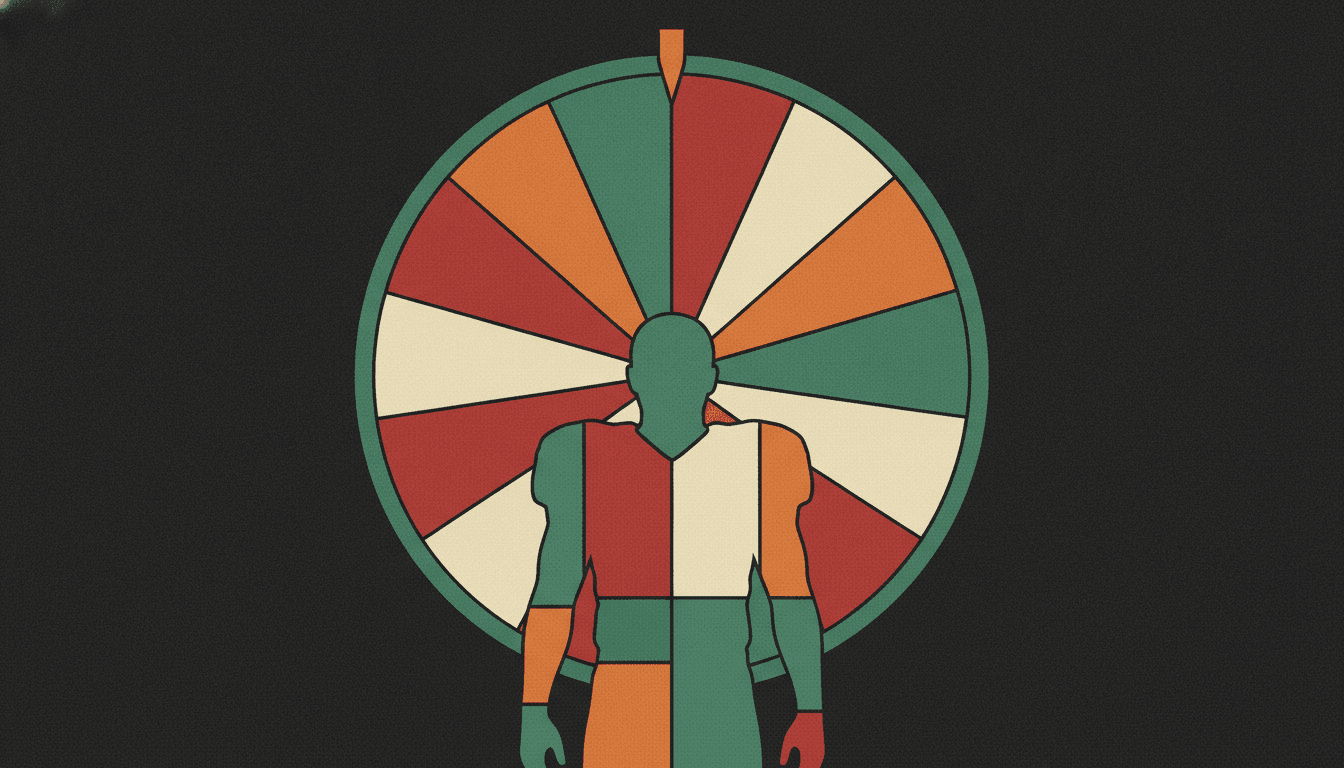
Build a Player NFL is the browser game where you make one football player out of pieces of ten real ones. A wheel lands on a real quarterback, you keep his arm or his accuracy, and the wheel spins again. Ten spins later you have a single player stitched together from ten careers, and the game sends him out for a full season to see whether your creation can chase the numbers the real legends put up. It is quick, it is a little ridiculous, and "build a player nfl" is now a search thousands of fans type every month. This guide explains how the NFL builders work, using only their own public pages as we read them on November 27, 2026, puts the records they chase in context with verified numbers, and then covers the games on sacked.gg that scratch the same itch - starting with Career Mode, where the player you build plays a whole career, and Era Draft, where you build a whole team. sacked.gg is not affiliated with Build a Player or any site that runs one.
What Build a Player Is
Build a Player is a format, and 84-0.com runs NFL versions at three positions. The site groups them under a "Build a Player" heading with a one-line pitch: build a player "by choosing one attribute from each sports legend, then simulate the season and save your player card."
When we read the page, the NFL list had three builders:
- Quarterback, at 84-0.com/build-a-player/nfl/quarterback
- Running Back, marked new
- Wide Receiver, also marked new
The same section carried an NBA GOAT builder and three hockey builders (forward, defenseman and goalie), so the NFL versions are part of a wider family. The builders sit in what the site calls its Lab, next to its undefeated-season games.
A second site, build-a-player.com, runs its own take under the name Build-A-Player. Its homepage describes spinning the wheel "to create your Frankenstein NFL quarterback," simulating a full season and climbing an all-time leaderboard, with a basketball version called Build-A-Bucket beside it. Different site, same core idea: a wheel, a stack of real players, and one composite athlete at the end.
How a Build Works: Ten Spins, Three Passes
The rules fit on one line, and the quarterback page prints them that way: "Ten spins · one stat per player · no do-overs (okay, three passes)."
The page breaks a build into four steps:
- Spin a player. The wheel lands on a randomly selected real quarterback, shown with a set of attribute ratings.
- Keep one stat. You take exactly one of his attributes for your player and leave the rest.
- Fill all ten. Repeat until all ten slots are full. Three times in the build you can pass on a spin that does not help you.
- Sim the season. Your finished player gets a full 17-game season, and the results come back as a stat line.
That second step is the whole game. Every spin asks which of this player's traits your build needs most, and a great player is only as useful as the one rating you take from him. The three passes are the only defense against a bad wheel, so spending one early is a real gamble.
When the build is done, you can generate a share card with his ratings and his season, and save the build to a global leaderboard. The board has two player pools, Current Era and All-Time, and can be filtered by Today, Week and Overall. Saving a build and tracking your history takes a free account.
The Three NFL Builders: QB, RB and WR
Each builder uses the attributes that matter at its position. The ones named on each page when we read them:
- Quarterback: arm, accuracy, mobility and IQ on the sample card. The page's own description adds "arm strength, mobility, football IQ and other traits."
- Running back: power, vision, burst and balance, "plus other skills."
- Wide receiver: hands, routes, speed and YAC (yards after the catch), plus others.
The wide receiver page adds the one strategy hint the builders give away: "A well-balanced receiver may perform better" than one with a single huge rating. A receiver with elite speed and nothing else is a deep threat who drops the ball.
The Records Your Build Is Chasing
Every NFL builder names a real single-season record as the target. We checked each one against StatMuse while writing this:
- Quarterback: Peyton Manning's 5,477 passing yards. He set it with the Denver Broncos in 2013, in 16 games, completing 450 of 659 passes. He threw 55 touchdowns that season too, which is also the single-season record.
- Running back: Eric Dickerson's 2,105 rushing yards. He set it with the Los Angeles Rams in 1984 on 379 carries, again in 16 games, at 131.6 yards per game.
- Wide receiver: Calvin Johnson's 1,964 receiving yards. He set it with the Detroit Lions in 2012 on 122 catches, in 16 games, at 122.8 yards per game.
Two of those records survived by a whisker. Drew Brees threw for 5,476 yards in 2011, one yard short of Manning. Adrian Peterson ran for 2,097 in 2012, eight yards short of Dickerson. Our guide to the NFL single-season records that still stand has the full story of both near-misses, along with the records nobody has come close to.
Why a 17-Game Season Changes the Math
All three records were set in 16-game seasons, and every build gets 17. The NFL moved to a 16-game schedule in 1978 and added a seventeenth regular-season game in 2021. Manning, Dickerson and Johnson each played 16 games in their record years.
That extra game is worth a lot. At Manning's 2013 pace of 342.3 passing yards per game, one more game is roughly another 342 yards. At Dickerson's 131.6 per game, it is about another 132. A build that merely matches the record-holders' per-game rate would clear all three records with room to spare.
Real players have not found it that easy. In the five seasons since the schedule grew, the closest anyone has come, according to StatMuse:
- Passing: Tom Brady threw for 5,316 yards in 17 games in 2021, 161 short of Manning.
- Rushing: Saquon Barkley ran for 2,005 yards for the Philadelphia Eagles in 2024, in 16 games played.
- Receiving: Cooper Kupp caught passes for 1,947 yards for the Rams in 2021, 17 short of Johnson.
So the extra game is real, but so is the gap. A build that breaks a record on the first try is doing something no real player has done in the 17-game era.
What Build a Player Does Not Try to Do
Build a Player is a one-season game, and that is a design choice, not a flaw. A build takes a few minutes and the card is ready to share. It does leave some things outside its scope:
- No career. Your player plays one season. He does not age, sign a contract, get traded or retire.
- No team around him. The builder makes one player, not a roster.
- No daily puzzle. Every run gives you different players. That is great for replay, but two friends cannot compare the same build on the same day.
That is where the games below start. If you loved building a player, the next step is a game where he keeps playing. If you loved the wheel of real players, the next step is a wheel that builds a team.
The Best Alternative: sacked.gg Career Mode
Career Mode is a free NFL career simulator where you create one player and he plays a whole career. Instead of a one-season sim, your rookie joins a league of up to ten friends in a shared, fictional football world and plays one simulated game every night at your league's kickoff - the commissioner's local 8 PM by default.
A season is up to 26 real days:
- Days 1 to 18 are the regular season, a 17-game schedule with a bye.
- Days 19 to 22 are the pro playoffs, if your team is still alive.
- Days 23 to 26 are the offseason: awards nights, contract day, draft night and camp.
Then the next season starts, and it keeps going until he retires. Retirement is your call from age 30, and it comes by 36. Along the way he climbs six chapters - Rookie, Starter, Franchise Player, Superstar, Legend and the Hall of Fame - and everything he does feeds a Legacy score.
You do not play the snaps yourself. The game plays itself at kickoff. Your job is the day before it: the daily trivia games you finish are his practice reps (three is full prep, six is locked in, ten is hot), and the focus you pick for the night moves his projected line up or down. After forty minutes on the air, he gets a grade from A+ to F against his own projection, a stat line and a box score. Every roster, result and stat line in that world is fictional, and the page says so.
How Career Mode Builds a Player
Where Build a Player borrows traits from legends, Career Mode starts you from a blank rookie. Creating one takes a few decisions, each with a cost:
- Position. Nine to choose from: QB, RB, WR, TE, LB, CB, S, EDGE and K. Position sets the stat line he is graded on - a quarterback lives on yards, touchdowns, picks and completion rate, a cornerback on pass break-ups and picks.
- Archetype. You pick two signature attributes. They start higher and train 20% and 10% cheaper for his whole career, so the game tells you to "pick the two you will actually feed."
- Creation points. Fifteen of them, at most eight in one attribute, spread across the eight ratings his position uses. A quarterback's are arm, accuracy, vision, pocket, mobility, deep ball, poise and durability.
- Team. Your favorite team is preselected, and the choice sets the difficulty. A contender wins more but shares the ball. A rebuilding team throws to you forty times.
- Name and number. Two to twenty letters, and any number from 0 to 99.
Then comes the Combine, and this is where trivia meets the build. Your accuracy across the day's drills sets your draft round, from one to seven, and a better round carries bonus attribute points that you place yourself. Fewer than three drills means round seven, but nobody goes undrafted - every rookie starts Week 1.
The trade is clear. Build a Player gives you a superstar in ten spins and one season. Career Mode can give you a seventh-round nobody and a career to turn him into a Hall of Famer.
Era Draft: Build a Team Instead
If the wheel of real players was the hook, Era Draft is the daily game for you. It is sacked.gg's NFL fantasy sim, and it builds a ten-man team instead of one composite athlete.
Each day fixes one sim era, a decade whose style shapes the whole season, and hands you a wheel of franchise eras. Each spin lands on a real team from a real decade, the 1990s Cowboys or the 1970s Steelers, and you draft any one player from that roster into an open slot. The ten slots are a quarterback, a running back, two wide receivers, a tight end, an offensive lineman, a defensive lineman, a linebacker, a defensive back and a kicker.
The decisions will feel familiar:
- Two respins for the whole draft, the Era Draft version of the three passes.
- An era tax. A man drafted from far outside the day's sim decade loses value, and a man drafted out of position loses some too. The chips show every hit before you commit.
- A season sim at the end. The tenth pick sims the season on the spot: 14, 16 or 17 games depending on the era, and a single-elimination bracket if you win half your games.
The big difference is that the wheel is shared. Everyone spins the same cells on the same day, so two friends comparing drafts are comparing decisions, not luck - the thing a random builder cannot offer. Your first run of the day is the scored one, and practice redrafts are unlimited until midnight. A perfect season is the grail: 17-0 in a 2020s sim, 16-0 in the 1980s to 2010s sims and 14-0 in the 1960s and 70s. Every record the sim prints is fictional.
If you came to Build a Player from a franchise sim, our guide to Football GM and other NFL GM games covers the roster-building side of the genre in more depth.
More Daily Games for Build a Player Fans
84-0.com also runs a Guess That Player game where team logos pop in one by one and you name the player. If that is part of your rotation, our daily Career Path works the same muscle: an NFL player's franchise-by-franchise journey, five rounds a day from easy to expert, with hints for draft slot and college. Our guide to guessing the NFL player in Career Path and Who Am I walks through how both play.
If the record chase was your favorite part, Higher or Lower is a straight test of stat sense.
For the full tour of what is out there, the best NFL trivia games online ranks the whole field.

Related Reading
- The NFL Single-Season Records That Still Stand
- Best Quarterbacks of All Time: The Greatest NFL QBs Ranked
- The Greatest Running Backs in NFL History, Ranked
- The Greatest Wide Receivers in NFL History, Ranked
Building a player is more fun when the wheel is fair and the season is real. Spin today's shared wheel in Era Draft, then create a rookie in Career Mode and give him a whole career to chase the records.