
The best offensive line in NFL history is the Dallas Cowboys line of the early 1990s, and the case fits in one sentence: it won three Super Bowls in four seasons while the running back behind it won three rushing titles. That answers the question the way most people ask it - the best o-line of all time, meaning the five men up front, not the best single lineman - but it is not the only defensible answer. Washington's Hogs won three titles with three different quarterbacks. Lombardi's Packers put three linemen in the Hall of Fame. The 1972 Dolphins produced the first pair of 1,000-yard rushers the league had ever seen. A line is the one unit in football judged almost entirely by what happens to other people, so this list is built on what the men behind each line did, plus the honors the linemen collected themselves. If you want the individuals instead, start with the greatest offensive linemen in NFL history.
How the Lines Were Ranked
A five-man unit leaves even less of a paper trail than a single lineman. Sacks allowed exist as a team number, but they belong to the quarterback's footwork as much as to the blocking, and every other number belongs to the running back. So each line here was judged on four things, in this order.
Titles first, because a line exists to win games. Then what the offense did behind it: rushing totals, scoring, and where the record is good enough, how rarely the quarterback went down. Then the honors inside the unit - Pro Bowls, first-team All-Pro selections and Hall of Fame classes - because voters who watched every week are the only peer review the position gets. Last, continuity: how long the same men lined up next to each other. A great line is five players who have stopped needing to talk to each other.
1. Dallas Cowboys, 1992-1995 - the Great Wall
Three Super Bowls in four seasons: 52-17 and 30-13 over Buffalo, then 27-17 over Pittsburgh.
The core was Mark Tuinei at left tackle, Nate Newton at left guard, Mark Stepnoski at center and Erik Williams at right tackle, and in 1994 Larry Allen arrived and started ten games at right tackle as a rookie before moving inside. Allen is the Hall of Famer of the group, class of 2013, with 11 Pro Bowls and six first-team All-Pro selections. Newton went to six Pro Bowls and was first-team All-Pro in 1994 and 1995. Stepnoski went to five Pro Bowls, Williams to four, with first-team selections in 1993 and 1996.
The proof is the man behind them. Emmitt Smith won the rushing title in 1992, 1993 and 1995, and in 1995 he ran for 1,773 yards and 25 touchdowns, an NFL record at the time. That season Dallas allowed 18 sacks, and four of the five starters - Tuinei, Newton, Allen and center Ray Donaldson, who had taken over from the departed Stepnoski - went to the Pro Bowl. It is the reason Emmitt Smith's place among the greatest running backs is argued about at all.
Tuinei is the thread through all of it: fifteen seasons, every one of them in Dallas, after arriving as a defensive tackle.
2. Washington, 1982-1991 - the Hogs
The only line on this list with a name that outlived the players in it.
Joe Bugel, the offensive line coach, coined it in training camp in 1982, and the five he meant were Joe Jacoby at left tackle, Russ Grimm at left guard, Jeff Bostic at center, Mark May at right guard and George Starke at right tackle. They averaged 273 pounds that year.
Washington won Super Bowl XVII with Joe Theismann, XXII with Doug Williams and XXVI with Mark Rypien, and Joe Gibbs is still the only head coach to win Super Bowls with three different starting quarterbacks. The constant across all three was the line. In 1983 John Riggins ran for 24 touchdowns at 34 years old. In 1991, with Jim Lachey at left tackle and Mark Schlereth at right guard, Washington went 14-2, scored a league-high 485 points and allowed nine sacks in sixteen games. Then Rypien was not sacked once in three playoff games, the last of them a 37-24 win over Buffalo.
Grimm is the only Hog in the Hall of Fame, class of 2010. Jacoby has been a finalist and is still waiting, which says a good deal about how little the honors system knows what to do with a unit.
3. Green Bay Packers, 1960s - the sweep
Five NFL championships in seven seasons - 1961, 1962, 1965, 1966 and 1967 - including the first two Super Bowls, covered in full in the greatest NFL dynasties of all time.
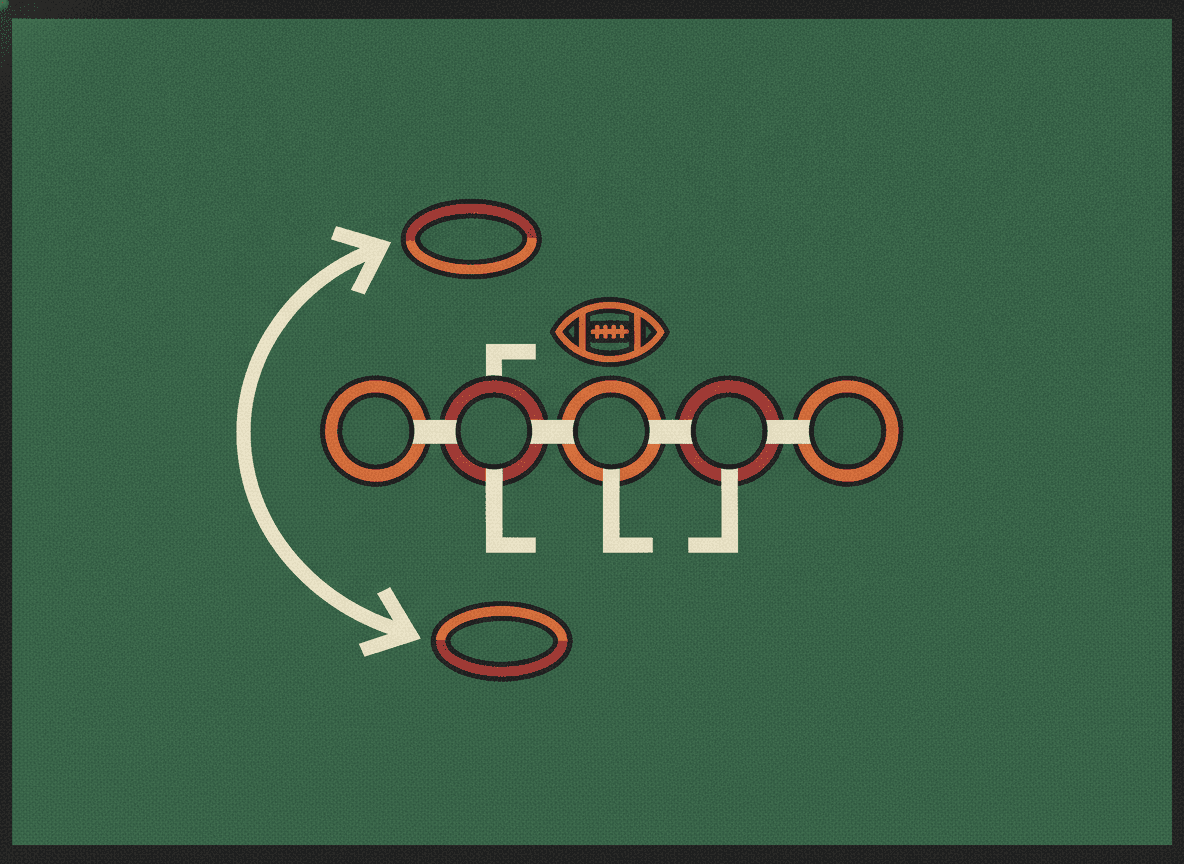
Vince Lombardi's offense was built on one play, the power sweep, and the play was built on the line: both guards, Jerry Kramer and Fuzzy Thurston, pulled to lead the runner around the end. Lombardi called it his No. 1 play "because it requires all 11 men to play as one to make it succeed, and that's what team means."
Three of the linemen are in the Hall of Fame: right tackle Forrest Gregg (1977), center Jim Ringo (1981) and Kramer (2018). Gregg collected nine Pro Bowls and seven first-team All-Pro selections, Ringo six first-team selections, every one of them as a Packer, before he left for Philadelphia in 1964, and Kramer five first-team selections. Kramer waited the longest by far: he was inducted at 82, fifty years after his last season.
He also threw the most famous block of all. In the 1967 NFL Championship Game against Dallas, the Ice Bowl, Bart Starr scored on a quarterback sneak in the final minute behind Kramer and center Ken Bowman, who took on Jethro Pugh between them, and Green Bay won 21-17.
4. Oakland Raiders, 1968-1976 - the left side
Three Hall of Famers on one line, and starters together from 1970 through 1974.
Center Jim Otto (class of 1980) played 210 games for the franchise from 1960 to 1974 and started every one of them. Left guard Gene Upshaw (1987), the 17th pick in 1967, and left tackle Art Shell (1989), who arrived in 1968, completed the set. Upshaw went to seven Pro Bowls with five first-team All-Pro selections, and Shell to eight Pro Bowls.
The left side is the part that became famous. In Super Bowl XI the Raiders beat Minnesota 32-14 and ran for 266 yards, a Super Bowl record at the time. Clarence Davis carried 16 times for 137 yards, and 11 of those carries went left, behind Upshaw, Shell and tight end Dave Casper.
Upshaw is the only player in NFL history to reach the Super Bowl with the same team in three different decades, after the 1967, 1976 and 1980 seasons. Shell became the Raiders' head coach in 1989, the first Black head coach of the NFL's modern era.
5. Miami Dolphins, 1972 - two 1,000-yard backs
Fourteen wins in fourteen regular-season games, three more in the playoffs, and the first teammates in league history to rush for 1,000 yards each.
Larry Csonka ran for 1,117 and Mercury Morris for exactly 1,000, a total he was given only after a statistician's error that had taken nine yards off him was put right. The team ran for 2,960 yards in fourteen games. In front of them were Bob Kuechenberg at left guard, Jim Langer at center, Larry Little at right guard, and Wayne Moore and Norm Evans at the tackles.
Two of them are in the Hall of Fame. Little (1993) was first-team All-Pro five years running, from 1971 to 1975. Langer (1987) was the more improbable story: undrafted out of South Dakota State, released in camp by Cleveland, signed by Miami, and on the field for every offensive snap of Super Bowl VII. Kuechenberg went on to six Pro Bowls.
6. Kansas City Chiefs, 2002-2005 - two Hall of Famers and an undrafted guard
The highest-scoring offense in the league two years running, and a running back who broke the touchdown record behind it.
Willie Roaf arrived from New Orleans in 2002 to play left tackle next to Brian Waters, with Casey Wiegmann at center, Will Shields at right guard and John Tait at right tackle. Kansas City led the NFL with 467 points in 2002 and 484 in 2003, and in 2003, going 13-3, Priest Holmes ran for 27 touchdowns, breaking the 25 Emmitt Smith had scored behind the Dallas line above.
Roaf (Hall of Fame, 2012) finished with 11 Pro Bowls and four first-team All-Pro selections. Shields (2015) went to 12 straight Pro Bowls from 1995 to 2006 and played all 224 of his games for the Chiefs. Waters is the story: undrafted in 1999, signed by Dallas after a college career at North Texas spent at tight end and then defensive end, and by 2004 and 2005 a first-team All-Pro guard. He was also the 2009 Walter Payton Man of the Year.
7. Denver Broncos, 1997-1998 - smaller, quicker, zone
Back-to-back Super Bowls, a 2,000-yard season and an MVP for a sixth-round running back.
Denver's line was built against the grain. Alex Gibbs, the Broncos' assistant head coach and line coach from 1995, popularized zone blocking there, and his lines were known for smaller, more agile linemen than the usual. The back he built it around was Terrell Davis, the 196th pick in 1995. In 1997 Davis ran for 1,750 yards, then 581 more in four playoff games, and was MVP of a 31-24 Super Bowl win over Green Bay, for an offense that led the league with 472 points. In 1998 he ran for 2,008 and was the league MVP, and Denver beat Atlanta 34-19 for its second title.
The 1997 line had a Hall of Famer at tackle in Gary Zimmerman (2008), in his final season, with Tom Nalen at center on his way to five Pro Bowls and Mark Schlereth at left guard. Schlereth links two lines on this page: he was a Hog first, won Super Bowl XXVI in Washington, and then won two more in Denver. It is exactly the kind of team journey Career Path asks you to trace.
8. Philadelphia Eagles, 2024 - 2,005 yards and a title
The most recent entry, and the one most likely to climb.
Jordan Mailata at left tackle, Landon Dickerson at left guard, Cam Jurgens at center, Mekhi Becton at right guard and Lane Johnson at right tackle. Saquon Barkley ran for 2,005 yards behind them, the ninth 2,000-yard season in NFL history, and 2,504 including the playoffs, which broke the combined record of 2,476 that Terrell Davis had set behind the Denver line above. Philadelphia went 14-3, ran for 3,048 yards as a team and beat Kansas City 40-22 in Super Bowl LIX.
The construction is the interesting part. Mailata was a seventh-round pick, 233rd overall in 2018, out of rugby league, without a single down of American football behind him. Becton was a 2020 first-round tackle from the Jets, playing guard on a one-year deal. Jurgens was in his first season at center, in place of the retired Jason Kelce. Johnson, Jurgens and Dickerson went to the Pro Bowl, and Johnson and Mailata were second-team All-Pro.
Honorable Mentions
1984 Los Angeles Rams - Eric Dickerson ran for 2,105 yards, still the single-season rushing record more than forty years later, behind a line anchored by right tackle Jackie Slater, who played 20 seasons and 259 games for the Rams and reached the Hall of Fame in 2001.
1970s Pittsburgh Steelers - four Super Bowl wins in six seasons. Mike Webster (Hall of Fame, 1997) was the backup to Ray Mansfield for the first two and the starting center by the third, and went on to nine Pro Bowls.
2014 Dallas Cowboys - three first-round picks in four drafts: Tyron Smith ninth overall in 2011, Travis Frederick 31st in 2013 and Zack Martin 16th in 2014. DeMarco Murray ran for 1,845 yards, and Smith and Martin were both first-team All-Pro that year, Martin as a rookie. Martin went on to seven first-team selections and started all 162 games he played.
What the Great Lines Have in Common
Three things repeat.
The first is at least one Hall of Famer, and rarely more than two. Dallas had Allen, Washington had Grimm, Denver had Zimmerman, Kansas City had Roaf and Shields, Miami had Little and Langer. Green Bay and Oakland, with three each, are the exceptions, and they are also the oldest lines here, from an era when a great unit could stay together for most of a decade.
The second is a coach and a system with the line at the center of it. Lombardi's sweep, Bugel's Hogs and Gibbs's zone scheme are remembered as much as the players inside them, because the system is what let five men act as one.
The third is that the great lines are full of players nobody expected much from. Langer and Waters went undrafted. Mailata was the 233rd pick and had never played the sport. The running backs who made the lines famous were often bargains too: Davis was the 196th pick. A line is a unit before it is five resumes, and the best ones were assembled by people who knew the difference.
Related Reading
- The Greatest Offensive Linemen in NFL History
- The Greatest NFL Dynasties of All Time, Ranked
- The Greatest Running Backs in NFL History, Ranked
- The Greatest Pass Rushers in NFL History, Ranked
The lines on this list span six decades, and that is the whole idea behind our daily Era Draft: spin the wheel, draft a ten-man roster from real franchise-era teams, one offensive lineman included, and sim a season. Or trace a player's team journey in Career Path.